



24/7 Emergency Phone Phone +34 930 474 411
Person regaining their privacy after removing their personal data from the internet with RepScan
G★★★★★4.9/5

Personal data removal service

Remove personal data from the internet

We find where your personal information appears online and handle its removal on a legal basis. Your name, address, phone number or private documents can stop showing up on Google or disappear from the website that published them.

Your full name on GoogleExposed address, phone number or emailID numbers, bank details and private documentsPersonal photos published without your permissionData on people search sites and forumsOfficial gazettes and public records, through the right to be forgotten
Google Partner: trusted content removal program100,000+ pieces of content removed, protecting the reputation of individuals and companies.

Real Betis Balompié
Direct Seguros
Norauto
Federació Catalana de Futbol
Maestro Pizza
Llorente y Cuenca
Barcelona Activa
Acceso
Asociación Violencia Digital
Grupo Sagardi
Grupo San Telmo
Clínicas Egos
Tablao Flamenco Cordobés Barcelona
Net Craman
Real Betis Balompié
Direct Seguros
Norauto
Federació Catalana de Futbol
Maestro Pizza
Llorente y Cuenca
Barcelona Activa
Acceso
Asociación Violencia Digital
Grupo Sagardi
Grupo San Telmo
Clínicas Egos
Tablao Flamenco Cordobés Barcelona
Net Craman

We can remove personal information from the internet, legally

If your name, address or phone number shows up on Google without your permission, anyone can see it, save it and use it.

We find where your data is and request its removal on a legal basis, with a 96% success rate:

Your full name in Google resultsAddress, phone number or email published without permissionLeaked ID numbers, bank details or private documentsPersonal photos published without your consentData on forums, social media and databasesOfficial gazettes and public records, through the right to be forgottenLeaked private conversations and medical records
More privacyMore peace of mindLess exposure
Person regaining their privacy after removing their data from the internet with RepScan
4.6★★★★★
Results for your name on Google
★★★★★

[First Last] · phone and address

Removed ✓

How our personal data removal service works

From exposed data to privacy restored. Here's how we work: we find where your information appears, request its removal from each platform and make sure it doesn't come back.

★★★★★

We find your data online

We scan search engines, websites, forums, databases and records to find where your personal information appears.

★★★★★

We request removal on a legal basis

We prepare the request using the arguments each platform accepts and follow up until your data is gone.

3.1★
★★★★★★★★★★

You get your privacy back

Once the exposed data is removed, your name is no longer linked to information that should never have been public.

If the platform says no, we escalate

Reinforced review, legal arguments or de-indexing: the data can still come off Google.

How to remove personal data from the internet, step by step

Remove my data now ➜

Here are the steps to delete personal data online, and what we do when the platform doesn't remove it the first time.

01

Find where your data is

Find where your data appears online

Search your name on Google and on people search sites to see what data shows up and on which websites. Take screenshots of everything you find.

  • Your full name in search results
  • Websites or forums where your personal information appears
  • Type of exposed data: address, phone number, document
02

Identify the legal route

Identify the legal basis to remove your personal data

Depending on whether the data was published without your permission, is no longer relevant or violates your privacy, the route may be the GDPR, the right to be forgotten or your rights to honor and to your own image.

  • GDPR Article 17: the right to erasure of personal data
  • Right to be forgotten: to de-index outdated information from Google
03

Request removal from the platform

Removal request to the platform or search engine

Contact the platform or search engine showing your data and invoke the right that applies. Google has a dedicated form for the right to be forgotten.

  • Google's right to be forgotten form to de-index results
  • Direct request to the website or people search site
  • Follow-up until the data is confirmed gone
04

Leave it to RepScan

Leave it to RepScan and get your privacy back

We find your data, choose the most suitable legal route and file the request on your behalf. We let you know when it's gone.

  • You send us your case and we handle the entire process
  • Case follow-up and a reinforced request if needed
  • We notify you when your data disappears from the internet
Find where your data appears onlineIdentify the legal basis to remove your personal dataRemoval request to the platform or search engineLeave it to RepScan and get your privacy back

Rather not handle any of these steps yourself? We take care of everything, from finding your data to filing a reinforced request, and keep you updated at every stage.

Get started

Search result showing personal data that can be removed from the internet

Can personal data be removed from the internet?

Yes, when it violates your privacy or was published without a legal basis

Not all data that appears online can be removed. Here is the difference between the cases a well-built request can resolve and those it can't.

What data can be removed
  • Your full name linked to private information on Google
  • Address, phone number, ID number or bank details published without permission
  • Personal or intimate photos leaked without consent
  • Legal or medical documents accessible online
  • Outdated information, through the right to be forgotten
What data can't be removed
  • Information you published yourself and can delete directly
  • Data tied to public activity of current general interest
  • True facts accurately reported by the media
  • Content on sites with no identifiable complaints channel
  • Information the law requires to remain accessible
Is de-indexing the same as removing it at the source?

No. De-indexing means a result no longer appears on Google, even though the data is still on the website that published it. When the platform won't cooperate, de-indexing is the fastest way to stop your information from showing up when someone searches for you.

How long does it take to remove personal data from the internet?

It depends on the type of data and the platform. The most common cases are resolved within 24 to 72 hours. When a case has to be escalated with legal arguments, it can take several weeks.

RequestSame day
Platform review24 to 72 hours
Outcome or escalationDepends on the case
Data removal request filed the same day
Request

We file the request with the platform using the arguments it accepts.

Platform reviewing the personal data removal request
Platform review

The clearest cases, such as data on people search sites, are usually removed within this timeframe.

Personal data removed from the internet and privacy restored
Outcome or escalation

If the platform keeps the data up and it violates your rights, we reinforce the request on a legal basis.

WhatsApp

Would you rather tell us about your case on WhatsApp?

Message us and we'll get back to you quickly. Tell us what personal data you want removed from the internet and a specialist will assess your case, with no obligation.

24/7 support for urgent cases.

Message us on WhatsApp

Ongoing protection for your personal data online

Removing your data is the first step. Making sure it doesn't reappear is the next.

RepScan's ongoing protection service regularly monitors your name and data to detect any reappearance and act right away:

Regular monitoring of your name and data on GoogleAutomatic alerts for new appearancesRemoval requests handled for every reappearanceCoverage across search engines, websites and public databasesReports on the status of your online privacyNo need for you to keep an eye on anything
Discover the ongoing protection service
RepScan ongoing protection dashboard monitoring personal data online

Case · Personal data reappeared

Removal tracking

Alert received
Request sent to the platform
Data removed
Privacy restored4.2★
Right to be forgotten request to remove data from official gazettes and old news

Right to be forgotten: when your data appears in official gazettes or old news

Information published in Spain's Official State Gazette (BOE), digital newspaper archives or public records can also be de-indexed once it is no longer relevant. The right to be forgotten is the legal route to request it.

Our team checks whether your case meets the requirements and handles the de-indexing request with Google.

Request the right to be forgotten ➜

RepScan technology to find and remove your data online

The RepScan platform scans Google, people search sites and public websites to find where your data appears and handle its removal quickly.

Remove my data now ➜
Finds every source where your data appears

Our technology can scan Google, search engines, forums and public records to detect every appearance of your personal data online.

With a legal basis, we handle the removal

If there are legal grounds to remove it, we prepare the request. We check each piece of data against the applicable regulations before starting the removal.
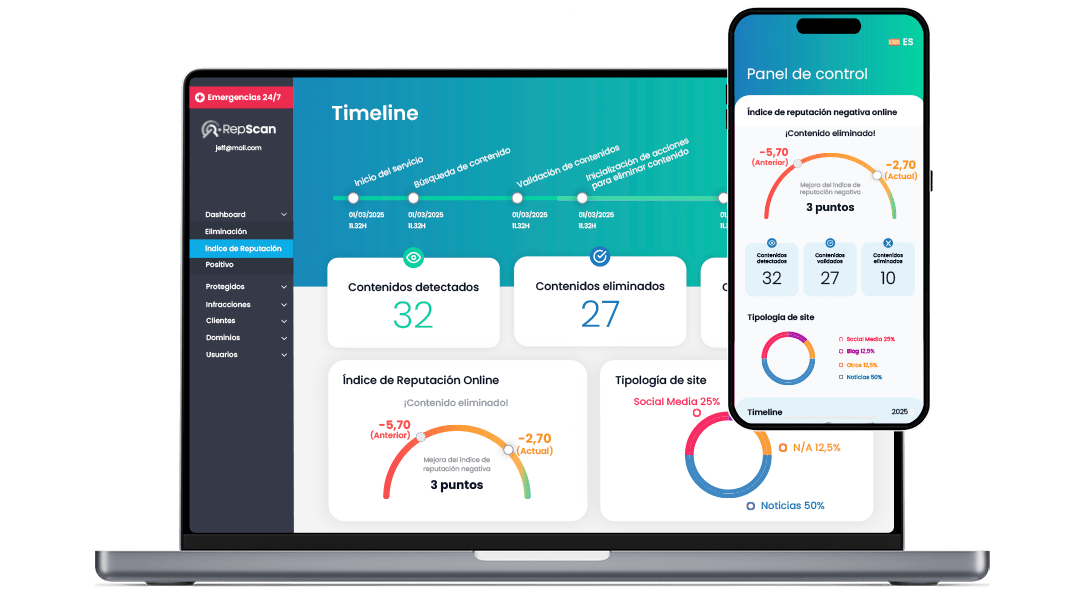

RepScan platform dashboard: locating personal data online and tracking the status of each case

EXPERIENCE

Remove your personal data from the internet and get your privacy back

Individuals and companies remove data that should never have been published. These figures reflect more than 15 years of removing content from the internet.

96%

Success rate

+5.800

Clients

+100K

Content removed

96%

Success rate

+5.800

Clients

+100K

Content removed

As featured in
El PaísLa VanguardiaForbesAntena 3TVEExpansiónEmprendedoresMobile World Congress
Premis Talent, Barcelona Chamber of CommercePremis Talent, Barcelona Chamber of CommerceENISABacked by ENISA

Visit the press room ➜
What our clients say
Santiago Segura
My picture was used in a miracle-pill scam. I got in touch with RepScan and, at last, someone took it seriously and sorted it out.

Santiago SeguraFilm director and actor
Santiago Niño Becerra
My name was tied to an investment scam with quotes I never said. I contacted RepScan and in just two days they removed everything.

Santiago Niño BecerraEconomist
Xantal Llavina
I hired them over a personal matter and RepScan acted straight away, with a fast and effective solution.

Xantal LlavinaJournalist and TV presenter
They also trust usReal Betis BalompiéSecuritas Direct

Frequently asked questions about removing personal data from the internet

There are two main options. If your name appears on specific pages, you can ask each website to remove it, or use Google’s right to be forgotten form so it stops appearing in search results, even if the data remains on the original site. Google assesses each request and accepts those that meet GDPR criteria. If the process feels complicated or your request is denied, our team handles the case for you.

“Results about you” is a free Google feature that lets you ask Google to remove certain personal data from its search results: phone number, address, email and intimate content published without consent. It works for one-off cases, but it has limits: it only removes the result from Google, the data stays on the website that published it and on other search engines, it doesn’t cover every type of data and Google may reject the request. When your data is spread across several sources or the website won’t remove it, you need to request deletion at the source on a legal basis.

Erasing your digital footprint 100% isn’t possible: some information is public by legal requirement, other data was published by the users themselves on websites they no longer control, and some sites have no complaints mechanism. What you can do is shrink your footprint significantly: remove data on a legal basis, de-index whatever stays at the source and make sure it doesn’t reappear. It’s an ongoing process, not a one-time, permanent wipe.

Yes. Article 17 of the General Data Protection Regulation (GDPR) recognizes the right to erasure: anyone can ask for their personal data to be deleted when it is no longer needed for the purpose it was collected for, when it was published without consent or when processing it has no legal basis. In Spain, the national data protection law (LOPDGDD) reinforces this right. Platforms and search engines must handle these requests when the conditions are met. RepScan manages the process under these regulations, without having to go to court.

The most common cases, such as data on people search sites or directories, are resolved within 24 to 72 hours of the request. De-indexing from Google usually takes anywhere from a few days to several weeks, depending on the volume of pending requests. When a case has to be escalated with legal arguments or the platform contests the request, the process can take longer. There is no guaranteed timeframe: it depends on the platform and how each case unfolds.

When the platform won’t cooperate or the data is on a site with no complaints channel, the most direct alternative is de-indexing: we ask Google to stop showing that result when someone searches your name. The data stays on the original website, but it is no longer visible. If de-indexing doesn’t succeed either, we keep the credit from your case so you can apply it to another service, as agreed with our team.

Official gazettes (such as Spain’s BOE and regional and provincial gazettes) publish data because the law requires it, so removal at the source is almost never possible. The usual route is the right to be forgotten: asking Google to stop showing that result once the information is no longer of public relevance. If Google refuses, you can file a complaint with the Spanish Data Protection Agency (AEPD). Our team checks whether your case meets the requirements and handles the request with Google.

Yes, partly. You can use Google’s right to be forgotten form and the “Results about you” tool, and contact the websites showing your data directly. It’s the slowest route and the one with the fewest guarantees: each platform has its own timeframes and criteria, and it can deny your request without explanation. If your data is on multiple sources, if the platform doesn’t respond or if you’ve already tried without success, RepScan’s service handles the case on a legal basis and follows it through to resolution.

Your full name linked to private information on Google, postal address, phone number, email address, ID number and bank details, leaked personal or intimate photos, legal or medical documents accessible online, private conversations, data on people search sites and databases, information on forums and social media, and entries in official gazettes or newspaper archives when the right to be forgotten applies.

It depends on the case: the type of data, how many sources it appears on and the work involved (a standard request or legal escalation). At RepScan, we assess each situation before we start so you know the scope upfront, with no surprises.

Removing data at the source means it disappears from the website that published it. De-indexing means Google stops showing it in search results, but the data remains on the original site. When the platform won’t cooperate or has no complaints mechanism, de-indexing is the fastest alternative to stop your information from showing up when someone searches your name.

Yes. People search sites and directories gather data from public records, social networks and other sources and publish it without asking. Most have an opt-out form, but each one works differently and the process is slow. We request removal from every site where your data appears and follow up until we confirm it’s gone.

It depends on whether there’s a legal basis for the request. If the data was published without your permission, if the content is false or if it violates your honor or your image, you can request removal from the platform by invoking the rights recognized under the GDPR and Spanish law. If the platform keeps it up, you can request de-indexing from Google. Tell us about your case and we’ll tell you what your options are.

When the data is removed or the results are de-indexed from Google, we let you know. You can check by searching your name on Google or directly on the platform. If you sign up for the ongoing protection service, we regularly check that your data doesn’t reappear and alert you if we spot anything new.

Tell us about your case

Tell us what personal data you want removed from the internet and we'll tell you whether it can be removed and how we'd do it, with no obligation.