





Right to be forgotten removal service
We exercise your right to be forgotten to protect your image online
We ask Google and websites to remove information about you that no longer needs to be there: old news, court rulings, official gazettes and personal data. We prepare the request with lawyers and follow it up if the first answer is no.
 +100,000 pieces of content removed and 5,800 clients in 65 countries. Your case is handled by a lawyer and treated with absolute discretion.










+100,000 pieces of content removed from search engines, media outlets and websites around the world.
What information can be removed with the right to be forgotten
The right to be forgotten applies to information about you that was published some time ago and no longer serves any purpose today: it is old, inaccurate or was published without reason. It does not have to be false.
Usually that information stays alive for one reason only: it shows up on Google when someone searches your name. That is why almost every case starts with the search engine, and some continue with the website that published it.

News story from 2014, still on Google
Removed ✓From first contact to it no longer showing up, step by step
Remove it now ➜These are the steps we follow when a case reaches us. If you would rather try it yourself, in the guide when the right to be forgotten applies we explain how to request it.
You tell us what you want removed

You don't need to bring the work done. With your name, a link or a screenshot we can get started.
- The link or a screenshot of the result
- What year the information is from and what it says
- Whether you already asked Google and what they replied
We assess whether it can be requested
Not everything can be removed: it depends on how old the information is, whether you are a public figure and whether there is still public interest. We tell you honestly what has a chance before requesting anything.
- Age of the information and current relevance
- Whether you are or were a public figure
- Copies on other websites and other search engines
- Google results for your name
We submit the request
To the search engine, the media outlet or the body that published the information, each with its own argument. And if they say no, we file a complaint with the AEPD.
- Erasure request to Google and other search engines
- Request to the website to delete or anonymise
- Complaint to the AEPD if they refuse
We confirm and keep watching

We let you know when each link stops showing up. From then on, if you want us to keep watching, monitoring is contracted separately.
- Notice link by link when it stops showing up
- If we can't remove it, we keep your credit for you
- Monitoring of reappearances: separate service, not included
Would you rather not go through any of these steps? We handle the whole process, from finding the results to filing a complaint if Google says no.
See the services
Where does that information keep appearing?
Hardly anyone finds it by looking for it. It appears when someone types your name into Google: a client, a company about to hire you or someone you have just met.
Sometimes a media outlet published it years ago. Other times it is an official gazette or a directory that copied your data. The source varies, but it is almost always in one of these five places.
Digital media and newspaper archives
News from years ago that is still in the outlet's archive and ranks well on Google. This is the most common case and the one that weighs most when someone searches your name.
- News about proceedings that have already closed
- Articles other media outlets copied from the original
- Archives open to search engines
Official gazettes
Edicts, fines, penalties or notices with your name in national, regional or provincial gazettes. The body is asked to stop showing them in search engines.
Court ruling websites and directories
Portals that publish court decisions and directories that compile names, positions, addresses and phone numbers from other sources.
Google and other search engines
This is where the right to be forgotten really applies: the link stops showing up when someone searches your name, even if the information stays on the original website.
Forums, social networks and old websites
Comments, profiles and photos from years ago on forums, blogs or networks you no longer use. They are claimed from the website and, if it does not reply, from the search engine.
How long does it take to stop showing up on Google?
It depends on who has to decide and on whether the first answer is yes. Google, media outlets and public bodies have their own timescales, and if a complaint has to be filed with the AEPD, it sets the timescale, not us. That is why we do not promise timescales.

Assessment and request
As soon as we have your name or the links, we find the results and send the first requests. We don't wait until we have the full picture to get started.

Search engine response
Google has its own form for the right to be forgotten and replies through it. If it refuses, a complaint can be filed with the AEPD, and that makes the process longer.

Removal from the website
The link disappearing from Google does not delete the information from the original website. When there are grounds, we also ask the media outlet or the body to delete or anonymise it.
The legal basis for exercising the right to be forgotten
It is a right recognised in Europe since 2014 and in Spanish law since 2018. These are the rules each request is based on:
We prepare each request with the rule that fits your case and submit it to Google, to the website and, if necessary, to the AEPD.

Why exercise the right to be forgotten?
Old information does not expire on its own. As long as it shows up on Google, anyone who searches for you will read it as if it were from today.

Case · News story from 2015 on 5 websites
Request tracking
We make it stop showing up when someone searches your name
On Google and other search engines, with a legal basis and complete discretion. Let your name reflect who you are now.
Today the first thing that shows up is something from years ago, and anyone who wants to hire you or work with you sees it.
Your name, up to date
We ask for the link to be removed from Google and, if there are grounds, for the website to delete it.
You have to explain it every time someone searches for you.
No more explanations
When the information stops showing up, you no longer have to get ahead of things by telling a story that is already over.
It appears on websites you didn't even know about.
The copies too
We also request the copies on directories and aggregators, not just the link you sent us.
Hours go by filling in forms.
You get your time back
We take care of searching, requesting and filing complaints if they say no. You get a notice when each link stops showing up.




Removal services for your case
Each service is contracted separately and without a subscription, except continuous monitoring. If we can't remove it, we keep your credit for you for the future. Prices are in the shop.
 Most common
Remove news
For old news that is still in the outlet's archive and shows up when someone searches your name. We ask for it to be removed from Google and, if there are grounds, for the outlet to delete it.

Remove court rulings
For rulings, orders and edicts published on legal portals and in official gazettes. We ask for them to stop showing up with your name in search engines.

Remove photos
For photos of you that were published without your permission or that you no longer want on the internet, on the website where they are and on Google.

Remove personal data
When your address, phone number, ID number or email appear in directories and websites. We delete that data from wherever it has been published.
 Start here
Pro scan
A report of everything that appears on Google with your name. Useful when you know there is something old but not where or how much.
 Continuous monitoring
RepScan Care Pro+
So you don't have to search again. We constantly check whether the information reappears on other websites, handle the removals and send you a report every month.
If your case does not fit any of these services, write to us and we will tell you what can be done before you pay anything. You can see the full catalogue in the RepScan shop or tell us your case.
The software we use to find every result with your name
The same platform we use to find everything that has been published about you and to keep control of the removals, link by link.
See the platform ➜It tracks by your name, by the headline and by the copied text across media, social networks, forums and search engines. This is what makes it possible to claim all the posts at once and not just the one you have seen.
Every link has its legal basis, date and status. You can see at all times what has been removed, what is pending and what has reappeared.
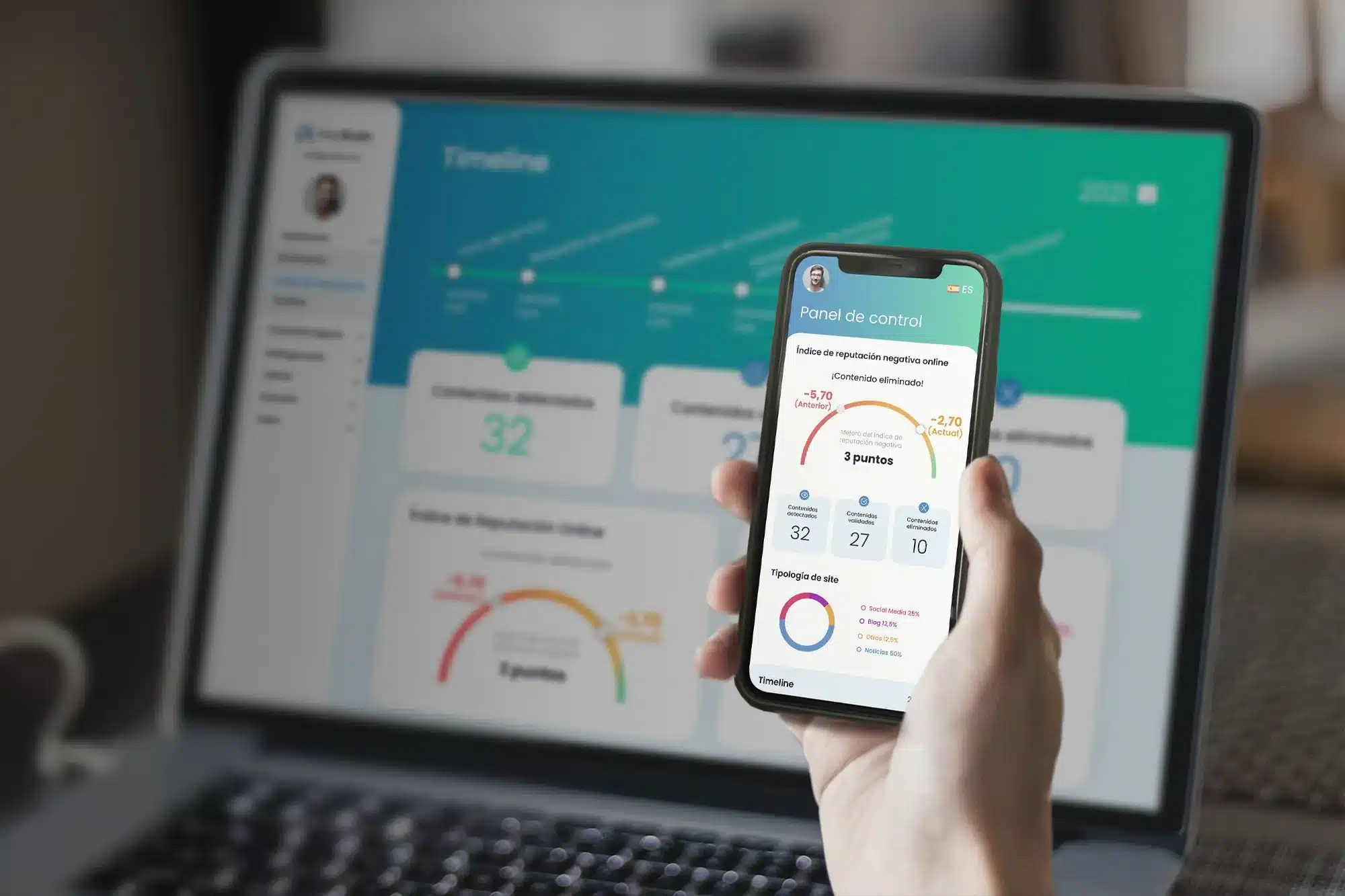

What already shows up, what gets copied tomorrow and what comes back
Old information is rarely in just one place. That is why the work does not end with the first link that stops showing up.
We find and request what shows up right now, including what is on websites and directories you didn't even know about.
While the requests are being processed we keep searching. If a new copy appears during the process, it is added to the same case.
It is common for a directory to republish your data or for another website to copy the news story. Monitoring checks this regularly and claims it.Contracted separately: not included in the removal.








 Premis Talent, Cambra de Comerç de Barcelona
 Company backed by ENISA

My image appeared in a miracle pills scam. I contacted RepScan and, at last, someone acted seriously and solved the problem.

My name appeared linked to an investment scam with phrases I never said. I contacted RepScan and in just two days they removed everything.

I hired their services for a personal matter and RepScan acted immediately, offering a quick and effective solution.